
# April 2026
Construction Blockchain Newsletter
This April edition centres on a clearer institutional shift in digital assets: the current signal is less about speculative crypto markets and more about regulated payment instruments, tokenised securities and the market infrastructure needed to support them. Recent developments from the BIS, ECB, SEC, HKMA and national authorities show continued movement towards formal frameworks for stablecoins, tokenised deposits and blockchain-based settlement. For construction and the built environment, that matters where payments, provenance, compliance and multi-party record-keeping intersect with regulated financial and data systems.
Across regions, the pattern is uneven but coherent. Europe is debating how euro-denominated tokenised money should scale without reinforcing dollar dependence. In Asia, Hong Kong has moved further into licensing and formal market structure. North America has continued to clarify legal treatment and prudential handling. In South America, the more notable signal remains practical commercial use, particularly the shift away from proprietary tokens towards dollar-linked instruments. In Africa, South Africa’s policy work on rand-pegged and foreign-currency-pegged stablecoins remains one of the more concrete regulatory exercises on the continent.
This month’s Research & Development Digest examines governed digital infrastructure in construction, with a focus on supply chains, ESG reporting and BIM-linked data architecture. The Events Agenda and Knowledge Upgrade then point to current opportunities to follow these developments in greater depth, including a more practice-oriented construction perspective.
🔊 Listen to the GenAI Newsletter Podcast 🔊 收听 GenAI 新闻通讯播客t 🔊 Ouça o podcast do boletim GenAI
Construction Blockchain
🔊 Listen to the GenAI Newsletter Podcast 🔊 收听 GenAI 新闻通讯播客t 🔊 Ouça o podcast do boletim GenAI Construction Blockchain
World & Blockchain
Worldwide

BIS urges coordinated stablecoin rules
The clearest global signal this month came from the BIS. In a 20 April speech in Tokyo, Pablo Hernández de Cos argued that stablecoins should be treated as a matter of monetary and financial architecture, not merely as a fast-moving product market. He noted that the market had reached roughly $315 billion in early April 2026, but that real-economy use remained modest relative to traditional payments. His main point was regulatory: fragmented national approaches risk arbitrage, market fragmentation and policy spillovers, especially in more vulnerable economies. For construction, the implication is indirect but relevant: any blockchain-based payment or assurance layer that scales internationally will depend on coordinated rules, not only technical interoperability.
Europe
Europe pushes harder on euro-denominated digital money
Europe’s April story is not one announcement but a convergence. ECB and Bank of France speeches have continued to frame tokenised deposits and euro-denominated stablecoins as part of Europe’s future market plumbing, with central bank money retained as the stability anchor. At the same time, Reuters reported on 17 April that France’s finance minister called for more euro-pegged stablecoins and backed a banking-sector initiative involving ING, UniCredit and BNP Paribas to launch one later in 2026. The direction is plain enough: Europe is trying to reduce dependence on dollar-linked digital payment instruments while keeping tokenisation inside supervised financial architecture.
Asia
Hong Kong moves from pilots towards licensed stablecoins
Asia’s strongest recent development came from Hong Kong. Reuters reported on 10 April that the HKMA granted its first licences for fiat-backed stablecoins to HSBC and Anchorpoint Financial, the latter a joint venture involving Standard Chartered, Animoca Brands and HKT. That matters because Hong Kong is moving beyond broad tokenisation strategy into actual licensing under a formal stablecoin regime. It fits with the HKMA’s March message that the future lies in integrating traditional and digital finance rather than choosing between them. The regional lesson is straightforward: serious jurisdictions are now testing whether digital money can be embedded into banking, payments and investment workflows under conventional supervisory controls
North America
SEC Clarifies the Application of Federal Securities Laws to Crypto Assets
North America’s most relevant updates remain regulatory. On 17 March, the SEC issued a clarifying release setting out a token taxonomy covering digital commodities, collectibles, tools, stablecoins and digital securities, and explaining how federal securities laws apply across those categories. Earlier, Reuters reported that U.S. banking regulators said banks would not face extra capital charges merely because securities are tokenised, stressing technology-neutral prudential treatment. Neither development resolves the wider political and legislative contest in Washington, but both reduce uncertainty at the level that institutions actually care about: legal classification, supervisory treatment and operational feasibility. That is more consequential than another cycle of crypto rhetoric.
South America
Mercado Pago drops loyalty token, keeps stablecoin focus
South America still offers more evidence of practical use than grand architecture. On 31 March, Reuters reported that Mercado Pago discontinued Mercado Coin, the proprietary token it had launched in 2022, while leaving in place its broader digital-assets activity, including Meli Dolar, its dollar-backed stablecoin introduced in Brazil in 2024. The move is modest, but it is telling. It suggests that branded ecosystem tokens are proving less durable than instruments linked to more familiar monetary functions. For built-environment observers, that distinction matters. Where blockchain survives in enterprise settings, it is more likely to be attached to payments, treasury or settlement logic than to promotional token schemes with thin operational value.
Africa
South Africa deepens formal work on stablecoin policy
Africa’s most concrete recent update remains South Africa’s Exchange Control Circular No. 3-2026. The document states that the Intergovernmental Fintech Working Group will assess in 2026 whether existing regulatory frameworks apply to rand-pegged stablecoin arrangements and examine the policy implications of foreign-currency-pegged stablecoins, with discussion papers intended for public consultation this year. That is a more serious development than most market commentary because it signals regulatory system-building rather than commentary from the sidelines. For infrastructure and real-asset sectors, this is the sort of work that eventually determines whether blockchain-based payment, escrow or reporting mechanisms can operate credibly in regulated settings.
Research & Development Digest
Blockchain & Governed Construction Infrastructure
This monthly Research Digest features three recent, verified papers that are directly relevant to construction rather than generic blockchain advocacy. The common thread this month is governed integration: supply-chain coordination, ESG assurance and BIM-linked data architecture.
Blockchain applications in the construction supply chain
Heydari M; Shojaei A, 2025.
This paper reviews 197 studies on blockchain applications in construction supply chains and is one of the stronger recent syntheses in the field. Its value lies in refusing to treat blockchain as a standalone cure. Instead, it maps recurring supply-chain problems such as poor coordination, weak information sharing, fragmented records and delayed payments, then assesses where blockchain may add value when combined with adjacent technologies and redesigned workflows. The paper also draws lessons from manufacturing, which is useful because construction literature too often behaves as though its problems are uniquely intractable. For practice, the real contribution is not enthusiasm but discrimination: the authors show that visibility, traceability and collaboration benefits depend on governance, interfaces and process design, not on ledger adoption alone. That makes it directly relevant to procurement, materials assurance and off-site delivery chains in the built environment.
DOI: https://doi.org/10.1016/j.autcon.2025.105998
Singh AK; Dugyala NR; Rahimian F; Elghaish F; Mohandes SR, 2025.
This article addresses a genuinely operational problem: ESG reporting in construction is often fragmented, difficult to verify and weakly connected across organisational boundaries. The authors propose and test a hybrid blockchain architecture using Ethereum, Hyperledger Fabric and IoT-linked inputs to improve transparency and accountability in ESG data handling. Its interest for construction extends beyond ESG itself. The underlying issue is evidential governance: who records data, who can validate it, and how records remain auditable across contractors, consultants and clients. That has obvious implications for embodied carbon claims, supplier reporting and regulated disclosure on major programmes. The paper does not prove that blockchain is ready for routine deployment at scale, but it does offer a more credible architecture for shared reporting than the usual broad claims about immutable trust.
DOI: https://doi.org/10.36680/j.itcon.2025.061
Hijazi AA; Alashwal A; Baghalzadeh Shishehgarkhaneh M; Calheiros RN, 2026.
This 2026 review is particularly useful because it moves the BIM–blockchain conversation onto firmer analytical ground. The authors identify six lifecycle stages, 29 workflows and 30 technical methods for integration, showing where blockchain is being linked to design, delivery, compliance and operational information. The strongest contribution is conceptual clarity. Rather than repeating vague claims about “trusted BIM”, the paper distinguishes data types, workflows and implementation mechanisms, including storage choices, smart contracts, hybrid architectures and access controls. For construction organisations, that matters because the real question is not whether BIM can be put on a blockchain, but which records should be anchored, automated or shared, and under what legal and operational controls. It is therefore directly relevant to digital assurance, traceability and model-governance strategy.
Events Agenda

Consensus 2026
5–7 May 2026, Miami, USA
Consensus remains one of the largest global gatherings in the sector, but the 2026 framing is notably institutional: stablecoins, tokenisation and the convergence of crypto, finance and policy are positioned at the centre of the programme. That does not guarantee substance; large events still tend to mix infrastructure with spectacle. Even so, it is a useful barometer of where market attention currently sits. For construction and real-asset professionals, the value is not the wider Web3 theatre but the concentration of discussion around settlement, custody, asset tokenisation and the operational claims now being made by financial institutions and infrastructure providers.
Digital Assets Summit 2026
13–14 May 2026, Convene, 200 Aldersgate, London
This is the more obviously relevant May event for an enterprise audience. Innovate Finance positions the summit around the convergence of crypto, blockchain and mainstream finance, with an in-person and digital format in London. The attraction here is less scale than focus. Events like this are where banks, infrastructure firms, policy stakeholders and institutional market participants test the practical contours of tokenisation, digital money and regulated digital-asset services. For built-environment readers, that matters because any serious application in construction will likely arrive through mainstream financial, legal and compliance channels rather than through crypto-native experimentation alone.
Point Zero Forum 2026
23–25 June 2026, Kongresshaus Zurich, Zurich
Point Zero Forum is useful precisely because it sits at the policy-technology boundary. The 2026 programme in Zurich brings together regulators, central banks and industry on themes including digital assets, payments, AI and financial policy. That makes it more relevant than a typical commercial blockchain event. The forum is not construction-specific, obviously, but it does address the institutional design questions that will shape whether blockchain-based systems for payments, reporting, tokenised assets or digital identity can become credible components of wider enterprise infrastructure. For this newsletter’s purposes, it is a better signal source than most vendor-led showcases.
Knowledge Upgrade
[New Book] Understanding Blockchain in Construction
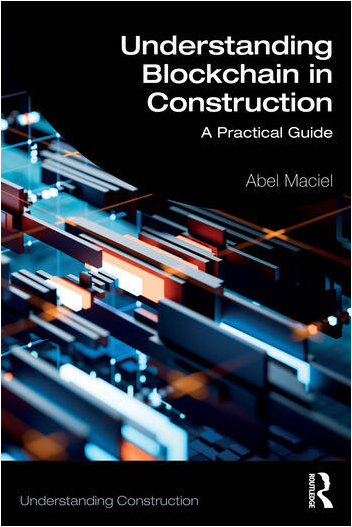
Understanding Blockchain in Construction: A Practical Guide
Provider: Routledge
Format: Book
Publication date: 2026
This month’s knowledge upgrade is slightly closer to home. Alongside writing this newsletter, I have also recently published Understanding Blockchain in Construction: A Practical Guide, a book intended to address a persistent gap in the sector: the lack of practical, construction-focused material on blockchain that moves beyond general hype or purely financial use cases. The book examines how blockchain relates to trust, traceability, smart contracts, data exchange and implementation challenges across construction and infrastructure contexts. It is written for professionals, researchers and decision-makers who want a more grounded understanding of where the technology may have real value in the built environment, and where its limits still need to be taken seriously.